
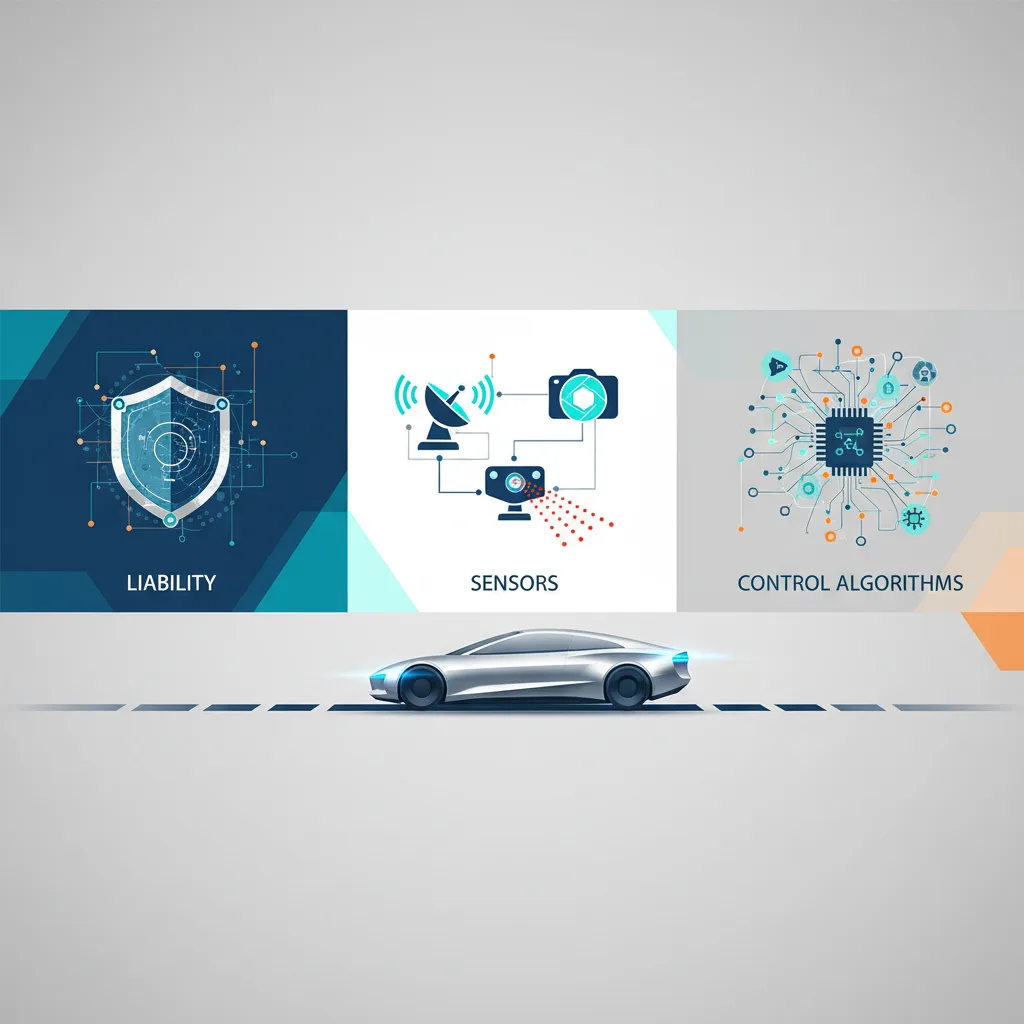
Here is something to consider: Predictions estimate that by 2030, the self driving vehicle market will balloon to $2.06 trillion. This projection emphasizes the incredible rate of technological progress and the massive financial backing propelling this sector. Companies are racing to develop and implement self driving technology; therefore, safeguarding their intellectual property is non negotiable. From my perspective, well conceived patent filings can cement market dominance in nascent tech industries. I will be discussing crucial elements of autonomous vehicle patents, with specific attention to liability after incidents, the critical function of sensor arrays, the software driving vehicle operations and the process to file a patent in India. My intention is to provide a granular examination of how to defend your inventions in this swiftly changing domain.
Who Is Responsible Following a Self Driving Car Crash?
A significant hurdle in the advancement of self driving vehicles is determining liability when incidents occur. Existing legal frameworks are unprepared for scenarios where a computer, rather than a person, pilots the car. This is precisely why autonomous vehicle patents covering safety enhancements and risk mitigation are so vital. I have personally observed how these patents can shield companies.
Securing Patents for Crash Prevention Tech
I am convinced that securing patents for advanced driver assistance systems and safety features is paramount. Consider these systems:
- Collision avoidance systems: Technology employing sensors and software to detect and avert collisions.
- Emergency braking systems: Software that forcefully applies the brakes when a crash is imminent.
- Lane keeping assist: Systems designed to maintain the vehicle within its lane.
Patenting these innovations not only defends your technology but also signals a commitment to safety, which can distinguish you from competitors.
How Patents Clarify Responsibility
Autonomous vehicle patents can delineate responsibility should something go awry. By patenting specific software or sensor configurations, companies can establish unambiguous lines of accountability. For instance, if a patented sensor system malfunctions and precipitates a crash, the patent holder could bear the responsibility. However, should the system perform as intended and a crash ensues due to an unforeseen circumstance, liability could shift elsewhere.
Sensor Tech and Patent Advantages
Sensors serve as the eyes and ears of self driving cars, delivering essential data for navigation and decision making. Patenting novel sensor technology is indispensable for maintaining a competitive edge. In my experience, improved sensors translate to safer and more efficient vehicles.
Indispensable Sensor Technologies
Several sensor technologies are absolutely crucial for self driving capabilities:
- Lidar (Light Detection and Ranging): Lidar systems utilize lasers to construct three dimensional maps of the surrounding area. Patents in this area often emphasize enhancing accuracy and expanding range and resolution.
- Radar (Radio Detection and Ranging): Radar employs radio waves to identify objects, even amidst adverse weather. Patents may encompass signal processing techniques or antenna designs.
- Cameras: Cameras capture images that the vehicle uses to discern objects and maintain lane position. Patents can center on image processing software or camera placement strategies.
- Ultrasonic sensors: These sensors facilitate short range detection, such as during parking maneuvers. Patents could address sensor placement or signal analysis methodologies.
Strategic Patent Approaches for Sensors
When pursuing autonomous vehicle patents for sensor technology, contemplate these approaches:
- Prioritize unique signal processing techniques: Develop innovative software to extract richer information from sensor data.
- Patent sensor fusion methodologies: Integrate data from disparate sensors to attain a more comprehensive understanding of the vehicle’s environment.
- Defend novel sensor designs: Engineer sensor designs that exhibit superior performance or reduced costs.
The Importance of Patenting Control Algorithms
Control algorithms function as the central processing unit of self driving cars. They analyze sensor data and dictate vehicle actions. Securing patents for these algorithms is pivotal for protecting the original concepts that enable self driving functionality. Algorithms are especially amenable to patent protection given the difficulty in reverse engineering them from the finished product. I have personally witnessed the significance of these patents.
Types of Control Algorithms Suitable for Patenting
Several control algorithms are fundamental to self driving cars:
- Path planning algorithms: These determine the optimal route for the vehicle. Patents could encompass strategies for managing moving obstacles or optimizing fuel efficiency.
- Decision making algorithms: These govern when to accelerate, decelerate or change lanes. Patents can spotlight how the system assesses risk or forecasts the actions of other drivers.
- Vehicle control algorithms: These oversee the car’s steering, acceleration and braking. Patents might address systems that adapt to evolving conditions or maintain functionality during component failures.
Algorithm Patent Strategies
When pursuing autonomous vehicle patents for control algorithms, deliberate on these strategies:
- Focus on inventive solutions to complex situations: Craft algorithms capable of resolving intricate driving scenarios, such as merging onto congested highways or navigating densely populated urban streets.
- Patent algorithms that enhance fuel efficiency or safety: Design algorithms that minimize fuel consumption, augment passenger comfort or bolster overall safety.
- Defend algorithms that exhibit adaptability and reliability: Engineer algorithms capable of accommodating fluctuating conditions and reacting to unforeseen incidents.
[A diagram illustrating the flow of data from sensors through control algorithms to vehicle actions. Alt Text: Data flow in autonomous vehicle.]
Protecting Your Concepts in India
India represents a substantial potential market for self driving cars; therefore, patent protection there is vital for companies conducting business there. The steps to file a patent in India involve:
The Patent Filing Procedure in India
- Conduct a patent search: Before submitting a patent application, a thorough search must be executed to ascertain the novelty and non obviousness of your invention.
- Compose a patent specification: The patent specification provides a comprehensive account of your invention, elucidating its operation and advantages. It should feature claims that explicitly define the scope of protection sought.
- Submit the patent application: The patent application must be dispatched to the Indian Patent Office (IPO). It should incorporate the patent specification, claims and supplementary documents as required.
- Address examination reports: Post submission, the IPO will scrutinize your application to assess its patentability. You may be required to address queries and furnish additional details.
- Patent grant: Should the IPO deem your invention patentable, it will issue a patent. The patentee then secures the exclusive prerogative to exploit, vend and import the invention within India for a span of 20 years commencing from the filing date.
Software Patents in India: Essential Information
India adheres to distinct regulations concerning software patents. Section 3(k) of the Indian Patents Act stipulates that software and algorithms are ineligible for independent patenting. Having said that, inventions exhibiting a technical effect may be patentable, notwithstanding their reliance on software. I advise consulting a patent attorney versed in Indian regulations.
The Trajectory of Autonomous Vehicle Patents
Autonomous vehicle patents are indispensable for safeguarding concepts, attracting investors and attaining a competitive advantage in the burgeoning self driving car sector. By prioritizing facets such as liability, sensor technology and control algorithms, companies can amass a formidable patent portfolio that defends their intellectual property. Acquiring knowledge of how to file a patent in India is equally salient for companies aspiring to expand there. As self driving technology advances, strategic patent maneuvers will exert increasing influence in determining industry leadership. After all, the destiny of autonomous vehicles hinges on robust intellectual property protection, and companies must act expeditiously to secure their position. I am certain that the entities possessing the most impregnable patent portfolios will emerge as the frontrunners of tomorrow. Securing autonomous vehicle patents is not just about legal protection; it is about charting the course for future innovation and market dominance.