
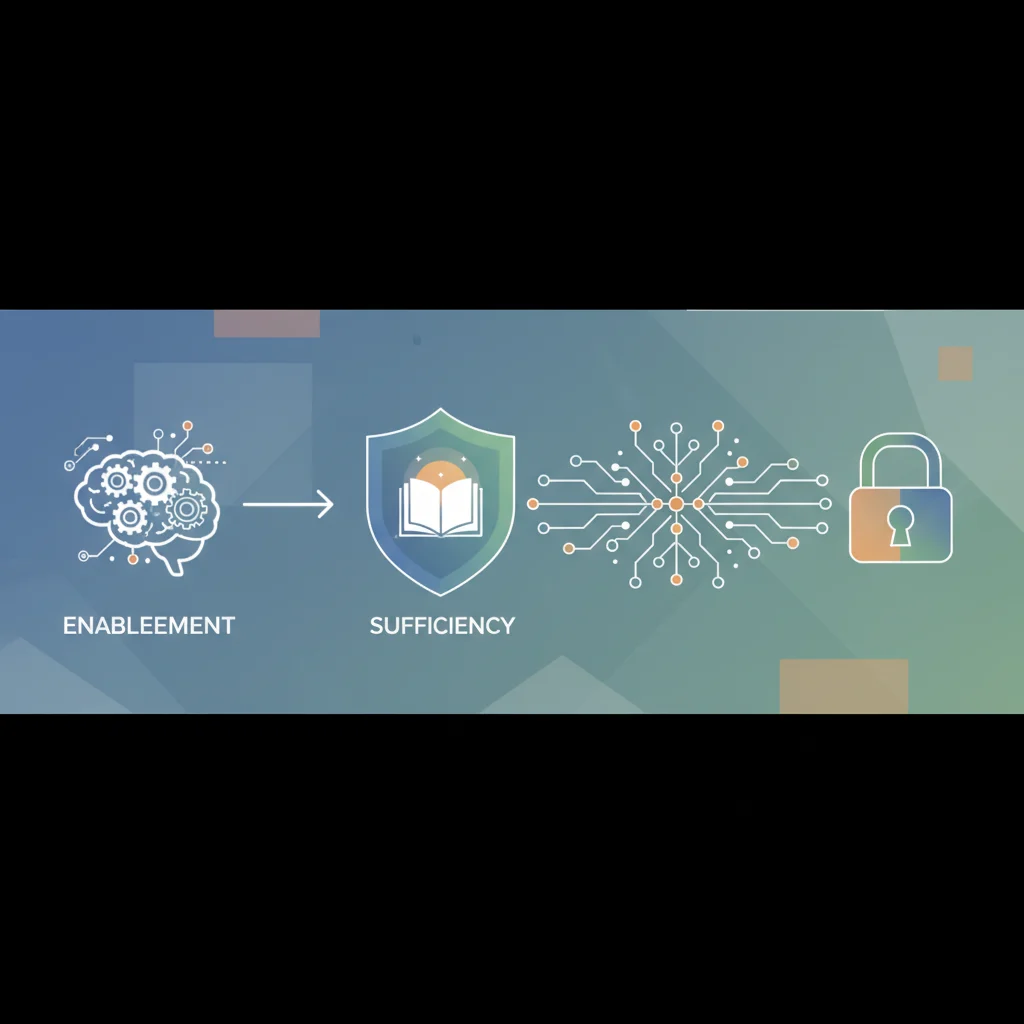
Consider this patent statistic nearly a third of initial patent applications face rejection. Having guided numerous inventors through this process, I can tell you a frequent culprit is a lack of clarity in demonstrating the invention’s enablement and sufficiency. Mastering these concepts is often the deciding factor between approval and rejection. I want to share insights into what patent examiners genuinely look for and explain how to draft specifications that not only meet but exceed their expectations. Protecting your intellectual property hinges on these critical details, and my aim is to ensure your invention receives the protection it truly deserves.
Decoding Enablement and Sufficiency in Patent Law
Enablement, in essence, means disclosing your invention with enough detail that someone skilled in the relevant field could build and use it without undue experimentation. Sufficiency is enablement’s counterpart. It means your description provides a complete explanation of the invention, covering its operation and performance. Think of it as providing a full recipe, not just a list of ingredients. If you intend to file a patent in India or anywhere else globally, grasping enablement and sufficiency is not merely advisable; it is absolutely essential.
Here is how I often illustrate it. Suppose you invented a self folding laundry basket. Your patent application cannot simply state the basket’s dimensions and the materials it is made from. You absolutely must detail the mechanisms, sensors and software that enable the folding action. Ask yourself this: If a patent reviewer examines your application and asks, “But how does the basket actually fold?” you have a major enablement problem. This demands careful attention.
Understanding the Patent Examiner’s Perspective
Patent examiners are not intentionally difficult; they are the gatekeepers of the patent system. Their job is to ensure that inventions are fully disclosed for the benefit of public knowledge. This exchange occurs because a patent grants a limited monopoly. When examiners assess enablement and sufficiency, they are essentially asking these questions:
- Is your description clear and comprehensive? Can someone with relevant knowledge readily understand the invention based on your specification?
- Are details missing? Have you overlooked or omitted crucial steps or components?
- Is extensive trial and error required? Would someone need to experiment significantly to make the invention work?
Patent applications that make broad claims without adequate support raise red flags. I recently reviewed a case where an applicant claimed a method for treating a disease using a novel compound. The documentation offered only a single example with minimal supporting evidence. The patent examiner rightly rejected the application because of a lack of enablement. The applicant failed to adequately demonstrate the compound’s general effectiveness against the disease. It proved to be a costly mistake.
Effective Strategies for Securing Patent Approvals Through Precise Specifications
So, what steps can you take to draft a specification that satisfies the examiner and results in patent approval? I have found the following strategies to be very helpful:
1. Start with a Comprehensive Description
Do not assume the examiner has any prior knowledge. Begin with a thorough introduction. Clarify the background, the problem your invention addresses and the invention’s core principles. Use clear and direct language, and avoid highly specialized jargon or technical terms that the examiner may not readily understand. I often advise clients to explain their inventions as if they were speaking to an intelligent friend who lacks specific expertise in the field.
2. Systematically Break Down the Invention
Provide detailed elaboration on each component or stage of your invention. Include diagrams, flowcharts and illustrations to help the examiner understand how it works. Include dimensions, materials and tolerances for mechanical inventions. If the invention involves software, explain the algorithms, data structures and interfaces in detail. Thoroughness is a significant advantage.
3. Provide Tangible, Real World Examples
Offer examples that show how your invention is made and used. These might include experimental data, simulations or calculations. The goal is to confirm the feasibility of your invention and demonstrate that it actually achieves the stated results. I assisted with a patent application for an improved solar cell that included comprehensive data from laboratory tests. This data demonstrated the cell’s efficiency and stability under various conditions, which was critical in convincing the examiner of the invention’s enablement.
4. Proactively Address Potential Problems
Do not avoid identifying potential issues or limitations. Explain how you addressed those issues and describe steps taken to mitigate remaining risks. This signals that you have thoroughly evaluated your invention. It also demonstrates transparency.
5. Maintain Clarity and Consistency in Language
Define all technical terms clearly and use them consistently throughout the specification. Avoid synonyms or ambiguous language that could confuse the examiner. Include a glossary if needed. I once had to revise an application because the applicant used “controller” and “processor” interchangeably, leading the examiner to believe they were discussing distinct components.
6. Know Your Audience
Consider the expertise and knowledge base of someone working in the relevant field. If your invention is highly specific, you can assume a certain level of specialized knowledge. If it is more general, you must provide additional context and explanation.