
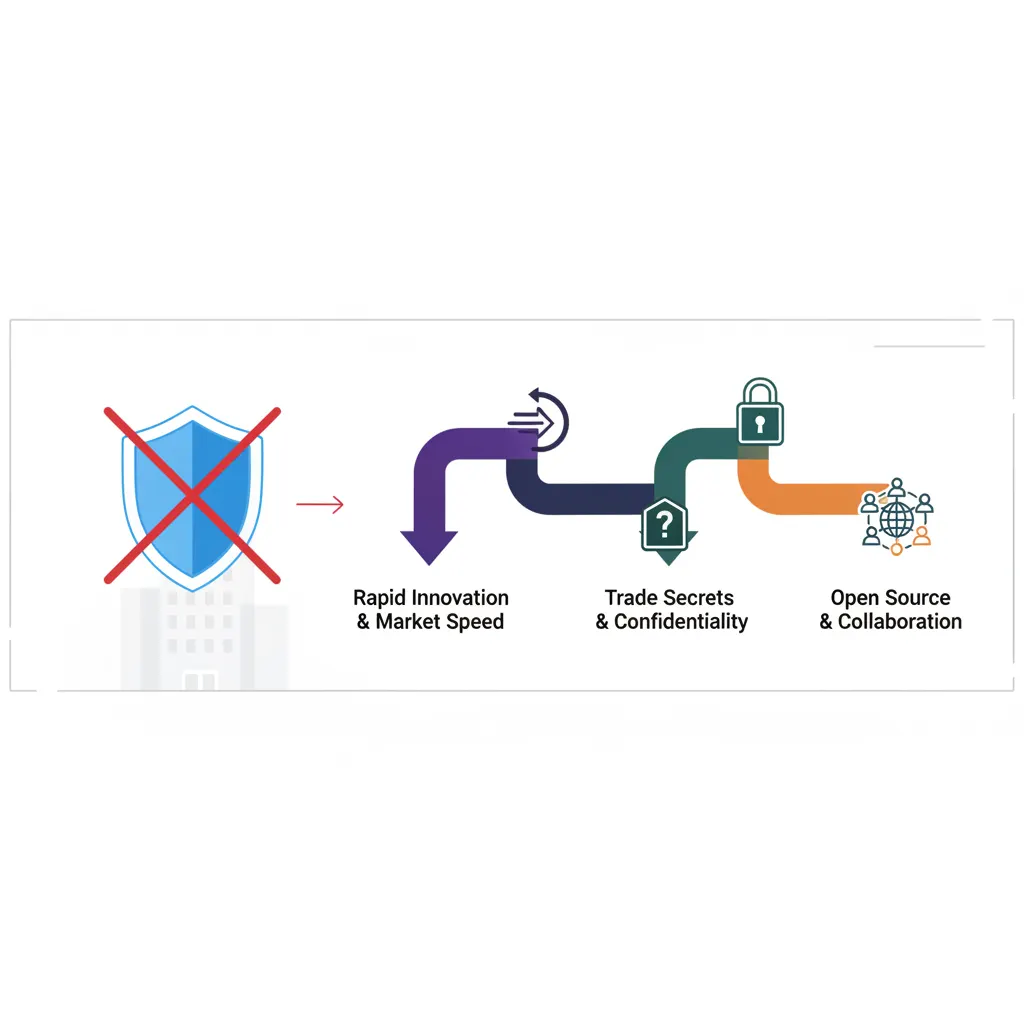
Here is a surprising statistic: nearly half of all patent applications filed in the United States never actually become patents. This comes from a 2023 report by the United States Patent and Trademark Office (USPTO). Sometimes, businesses decide that abandoning the pursuit of intellectual property protection is the smarter move. Knowing when it does not make sense to patent can save significant time and money. It might even create a stronger competitive advantage. I have seen several businesses benefit greatly from carefully weighing all their options.
The “Secret Sauce” Strategy: Trade Secrets
Patents require a complete explanation of how your invention operates. This makes sense for inventions that can be easily disassembled to reveal their inner workings, such as a new smartphone screen where rivals could quickly discern its construction. But what if your invention involves a technique, formula or process that can be kept under wraps? This is where trade secrets become invaluable.
Consider Coca Cola. The company’s recipe has been a closely held trade secret for over a century, providing more enduring protection than any patent could. Patents eventually expire, typically 20 years after the filing date, making the invention freely available. A trade secret, conversely, can potentially last forever, offering continuous exclusivity as long as confidentiality is maintained. I often counsel clients in the food and beverage industry to seriously consider trade secret protection for their unique recipes or production methods.
Key Considerations for Trade Secrets:
- Can the invention be easily reverse engineered?
- Are there strong measures in place to prevent information leaks?
- Will the invention still be relevant in 20 years?
If your answers indicate that secrecy is a viable option, pursuing a trade secret strategy may be the better choice.
Cost Benefit Analysis: Is Patenting a Worthwhile Investment?
Patents involve significant costs that add up fast. These include:
- Application Fees: The government charges fees for submitting patent applications.
- Legal Fees: You must compensate someone for drafting, submitting and defending the patent application. This often represents the biggest expense.
- Renewal Fees: Regular fees are needed to keep the patent valid.
- Defense Costs: You must cover legal expenses to defend the patent if someone infringes on it.
For a sophisticated invention, securing and maintaining patent protection across multiple countries can easily run into tens, or even hundreds, of thousands of dollars. I have seen startups invest heavily in patent applications only to find that the market demand did not materialize as expected. This reinforces the need for knowing when not to patent strategic and when it is wiser to allocate those funds elsewhere.
Before you file a patent application, carefully assess the potential return on investment. Ask yourself these questions:
- What is the anticipated market size for this invention?
- How long will this invention remain commercially viable?
- What is the chance of competitors infringing on the patent, and what would be the cost of enforcement?
If the projected revenue or competitive advantage does not warrant the investment, it may be more sensible to forgo patent protection and instead invest in areas such as marketing, sales or further research and development.
The Timing Game: Premature Filing
There is a temptation to rush and file a patent application as soon as an idea sparks. Filing too early, though, can be harmful. A patent application requires a complete and thorough description of the invention. Filing prematurely, before the invention is fully developed or tested, can lead to a weak patent. I once advised a client who had created a novel algorithm to postpone filing until they had real performance data to support their claims. This strengthens the patent application and makes it more defensible.
The patent landscape is always shifting. Competitors may introduce similar technologies. The market might change, rendering the invention obsolete. Filing too soon locks you into a specific description of the invention, limiting your ability to adapt to new developments.
Postpone filing until:
- The invention has been fully developed and tested.
- There is a solid understanding of the market opportunity.
- The business has a well defined commercialization strategy.
Waiting for the right moment ensures the patent application is as strong and relevant as possible.
The “Obviousness” Hurdle
One of the most common reasons for patent application rejections is obviousness. If the patent examiner decides the invention would have been obvious to someone skilled in the relevant field at the time of invention, the application will be rejected. This can be frustrating and expensive. Making matters worse, if you file a patent in India or other countries, similar problems will arise.
Before investing in a patent application, conduct a prior art search to assess your chances of clearing the obviousness hurdle. Examine existing patents, publications and other publicly available material to identify related technologies. I have used specialized search methods and databases to help clients determine whether their inventions possess novelty and non obviousness.
If the prior art search suggests the invention is likely obvious, abandon the patent application and think about alternative strategies. Consider trade secrets or aim for first mover advantage.
Strategic Publication: Blocking Competitors
Sometimes, you might not seek exclusive rights. You might only want to prevent competitors from obtaining patents on similar technologies. You can do this through strategic publication. Disclose the invention publicly in a journal, presentation or other accessible venue. By doing so, you establish prior art that can be used to invalidate later patent applications from competitors. This defensive tactic can be effective in fast moving industries where many businesses are pursuing similar innovations.
Strategic publication does not provide the same protections as a patent. Even so, it can deter competitors from monopolizing the technology, encouraging a fairer landscape.
Making the Right Decision
Deciding when not to patent strategic requires careful thought. Many factors must be carefully considered. Assess the advantages and disadvantages, analyze the competitive landscape and understand the limits of patent protection. You can then make informed decisions that align with the business’s goals. Sometimes, the most effective IP strategy involves not pursuing a patent at all.